
Kannad Emergency beacon Epirb M Safepro Ais Plus
Discover the distress beacon Kannad EPIRB M SafePro AIS Plus, the essential ally for your safety at sea.
Description
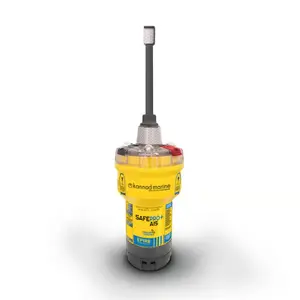
The Cospas-Sarsat satellite EPIRB Kannad SafePro AIS Plus beacon combines innovation and technology for safety at sea.
This next-generation EPIRB uses GNSS location receivers and is fully compatible with MEOSAR, allowing for greater location accuracy and faster alert transmission.
In addition to satellite transmission, the beacon emits target data and AIS man-overboard alerts.
The Cospas-Sarsat satellite EPIRB Kannad SafePro AIS Plus beacon combines innovation and technology for safety at sea.
This next-generation EPIRB uses GNSS location receivers and is fully compatible with MEOSAR, allowing for greater location accuracy and faster alert transmission.
In addition to satellite transmission, the beacon emits target data and AIS man-overboard alerts.
- GMDSS approved
- Floating, waterproof up to 10 m
- Optimised for MEOSAR: Improved detection capability for quicker rescue
- Aeronautical emergency frequency: 121.5MHz swept tone
- 406 MHz frequency: International distress frequency transmitted via satellites
- GNSS receiver: GPS(L1) + GALILEO(E1), 72 channels, ceramic patch antenna
- MOB AIS: AIS man-overboard alarm
- Manual or water activation
- Minimum 48 hours operating time
- Battery life
- Mounting options:
- Wall mount for Manual version
- Shock protection
- Powerful flashlight with 3 lights, 360-degree coverage
- Night vision with 3 I/R LEDs
GNSS? MEOSAR? WHAT IS IT?
Cospas-Sarsat is currently modernising its system by placing search and rescue receivers (i.e. repeaters or transponders) on board new navigation satellites operated by the United States (GPS), Russia (Glonass), which began its deployment last year, and Europe (Galileo), which started its launches on 12 October 2012.
Once operationally qualified, this system enhancement will significantly improve the speed of detection and location accuracy of beacons: (GNSS receivers = GPS + Galileo ** + GLONASS = 72 receivers compared to 12 GPS previously).
These satellites are placed in orbit around the Earth at altitudes between 19,000 km and 23,000 km, which is considered a medium altitude orbit.
This component of the Cospas-Sarsat system is named MEOSAR, for Medium Earth Orbit satellites for search and rescue.
It will complement the existing LEOSAR and GEOSAR systems.
Once fully operational, the MEOSAR system will offer the advantages of LEOSAR and GEOSAR systems without their current limitations, by transmitting the distress message and providing its location independently, with near real-time global coverage.
The MEOSAR system also brings other enhancements for Cospas-Sarsat beacons, such as a return transmission to the beacons that will confirm to users that the alert message has been received.
** Galileo has been increasing its capacity since 2016, aiming for its complete operational constellation in 2018/9
GNSS? MEOSAR? WHAT IS IT? Cospas-Sarsat is currently modernising its system by placing search and rescue receivers (i.e. repeaters or transponders) on board new navigation satellites operated by the United States (GPS), Russia (Glonass), which began its deployment last year, and Europe (Galileo), which started its launches on 12 October 2012.
Once operationally qualified, this system enhancement will significantly improve the speed of detection and location accuracy of beacons: (GNSS receivers = GPS + Galileo ** + GLONASS = 72 receivers compared to 12 GPS previously).
These satellites are placed in orbit around the Earth at altitudes between 19,000 km and 23,000 km, which is considered a medium altitude orbit.
This component of the Cospas-Sarsat system is named MEOSAR, for Medium Earth Orbit satellites for search and rescue.
It will complement the existing LEOSAR and GEOSAR systems.
Once fully operational, the MEOSAR system will offer the advantages of LEOSAR and GEOSAR systems without their current limitations, by transmitting the distress message and providing its location independently, with near real-time global coverage.
The MEOSAR system also brings other enhancements for Cospas-Sarsat beacons, such as a return transmission to the beacons that will confirm to users that the alert message has been received.
** Galileo has been increasing its capacity since 2016, aiming for its complete operational constellation in 2018/9
Additional information
| Brand | Kannad |
| Supplier reference | KA-23-002-011A |
| Color | yellow |
| Color | Yellow |
| Gender | Mixed |
| Age group | Adult |