
Rugby boots for forwards and backs


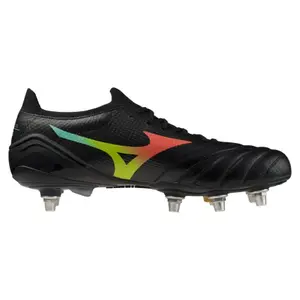


The Rugby Shoes page brings together the studs for both male and female players: adidas Kakari for forwards, adidas RS in Elite and Adizero Pro versions for backs, Gilbert Torq and Power, Mizuno Waitangi in leather, Canterbury Stampede. There are screw-in stud soles for the wet grass pitches of winter, available in men's and women's sizes, for the props as well as the wingers.
The right support, both in the scrum and when running.
Forwards or backs: a shoe for each position
In rugby, the shoe matches the position. Forwards, props, hookers, second and back rows, push in scrums, rucks and mauls: they look for a sturdy sole, a high ankle support and a large number of studs, often eight, to maximise anchor points, like the adidas Kakari or the Gilbert with eight studs. Backs, halves, centres, wingers and full-backs, sprint, sidestep and kick: they prefer a low and light shoe, like the adidas RS in the Adizero Pro version, designed for speed bursts and quick footwork. Back rows, straddling the two roles, often choose a mid-range model.
The rest of the gear
Rugby also includes:
- Balls.
- Gear, helmets, shoulder pads, and mouthguards.
- Clothing.
- Rugby shirts.
- Rugby polos.
- Clubs.
- Nations.
All things rugby can be found on the rugby page.
Screw-in or moulded studs: what the rules say
Shoes marked SG, for soft ground, feature screw-in studs, made of aluminium or plastic, which are replaced based on wear and the ground conditions: longer studs for winter mud, shorter on dry grass. Moulded studs, fixed to the sole, are suitable for hard and synthetic surfaces. World Rugby regulations oversee these studs: their length must not exceed twenty-one millimetres and their edges must be rounded, without any sharp or jagged edges that could injure a player on the ground. The referee or their assistants can check shoes before kick-off and require a damaged stud to be changed.
Leather or synthetic, and after-match care
The leather upper, like on the Mizuno Waitangi, moulds to the foot over time and provides a precise feel for kicking; it needs to be maintained with a conditioner or cream to remain supple. The synthentic, being lighter, can be washed with water and dries more quickly after a rainy match. In both cases, mud should be removed immediately after leaving the pitch, shoes should be stuffed with newspaper and left to dry at room temperature, away from radiators that can crack the leather. Before each match, check the tightness of screw-in studs with the supplied key: a loose stud can get lost mid-game.
Great deals
Good bargains can also be found in the great deals, promotions, clearance, sales, and Black Friday. The new arrivals showcase the latest collections, and items shipped within 24h are prepared and dispatched in 24 hours. Key moments of the year follow a consistent order: Black Friday in late autumn, the year-end holidays, winter sales, French Days in spring, followed by summer sales and back-to-school.
Frequently asked questions
Can you play rugby with football shoes?
In rugby school or for a full-back on dry ground, a football shoe with moulded studs can work, as long as the studs are rounded. Forwards need the grip and durability of a proper rugby shoe to push in scrums.
What size should you get for rugby shoes?
Take your usual size, tried on with match socks, leaving about half a centimetre in front of your toes. The heel should stay locked during pushes; a leather shoe will stretch a bit, a synthetic one will hardly stretch at all.
What rugby shoe for a child?
In rugby school, a shoe with moulded studs is lighter, simpler, and versatile on dry or synthetic surfaces. Screw-in studs become useful later, when the young player is playing on wet grass in winter.
What studs should you bring in your match bag?
Bring a set of short studs and a set of long ones, the tightening key and a few spare studs. Adjust the length based on the grass condition during warm-up, and promptly replace any worn or damaged stud.
Do you need different shoes for sevens rugby?
Sevens rugby is often played in summer, on dry pitches, with a lot of running: players prefer low, lightweight shoes, sometimes with moulded studs, rather than the robust models of forwards in fifteen-a-side rugby.






