
Basketball balls on clearance


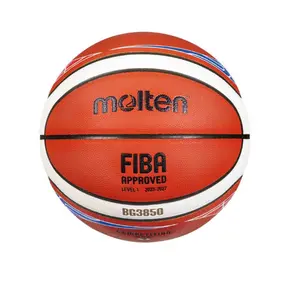


The discount basketball balls brings together end-of-line products for both the court and the playground: Spalding TF composite leather balls, Molten training balls, Nike and Jordan Playground rubber balls, Wilson three-on-three basketballs, balls in the colours of ASVEL, AS Monaco and Baskonia, NBA and WNBA balls, NBA Dribbler bouncy balls, and Tremblay foam balls for the little ones.
A ball for every court, at a reduced price.
Size five, six or seven: the right ball for the age
The French Basketball Federation assigns a ball size to each category. Size five, the smallest, is for children up to U11, around seven to ten years old. Size six is for U13 boys, and then for all girls from eleven onwards, up to seniors. The size seven, the largest, is used by boys from U15 and by men. Giving a child a ball that's too big affects their shooting and dribbling; it's better to stick to their category, even if it means changing balls in two or three years. For little ones, the foam ball Tremblay allows for quiet dribbling at home.
The other clearance items
The basketball clearance also includes:
- Shoes.
- Clothing.
- NBA, jerseys and franchise products.
- Accessories.
All clearance items are gathered on the basketball page.
Composite leather or rubber: hardwood or concrete
The material of the ball is chosen based on the playing surface. Composite leather, like that of the Spalding TF Gold, TF Silver or TF Legacy, offers a soft touch and precise grip on hardwood, but wears out quickly on concrete. Rubber, like that of the Nike Everyday Playground, Jordan Playground or Spalding Layup, withstands the abrasion of playgrounds and rain; its deep grooves maintain grip even with dusty hands. The training Molten balls, made of robust composite, keep up with club practice sessions. Spalding provided the NBA game ball from 1983 to 2021, before handing it over to Wilson.
The three-on-three ball: small but heavy
The three-on-three basketball, an Olympic discipline since the Tokyo Games, is played with a specific ball: it has the circumference of a size six ball, between seventy-two and seventy-four centimetres, but the weight of a size seven, around six hundred grams. This compromise makes it easy to handle with one hand and less affected by the wind on outdoor courts, where the discipline is often played. Its yellow and blue design makes it instantly recognisable. The Wilson ball in FIBA colours mimics its design for training in the fast-paced game of three-on-three, on a half court with just one hoop.
Pressure and inflation: maintaining a good bounce
A well-inflated ball bounces correctly: according to FIBA rules, dropped from a height of one metre eighty, it should rebound between one metre twenty and one metre forty. The recommended pressure, usually between half a bar and six-tenths of a bar, is indicated near the valve. To inflate, moisten the needle before pushing it straight in to avoid piercing the membrane, then check with the gauge. Over-inflated, the ball becomes hard and bounces too high; under-inflated, it slows down dribbling and wears its surface. An outdoor ball also loses pressure in the cold: this should be checked before each winter session.
Frequently asked questions
Why are basketballs orange?
Until the late fifties, balls were dark brown and hard to see well. American coach Tony Hinkle, in collaboration with Spalding, designed an orange ball, which was tested during the 1958 NCAA Final Four, and later adopted for its visibility.
Is there a silent basketball?
Yes, dense foam balls bounce silently and allow for dribbling in an apartment without disturbing neighbours. They are suitable for children and warm-ups, but their bounce is softer than that of a real ball.
How do you deflate a basketball?
Moisten the inflation needle, insert it straight into the valve without a pump attached, and gently press the ball: air escapes through the needle. Never use a sharp object, as it could pierce the valve.
Why can a basketball burst?
A ball typically bursts due to over-inflation, prolonged exposure to heat, like in a car in the sun, or impact with a sharp object. An aging bladder or worn stitching can also give way more easily.
How do you clean a composite leather ball?
Wipe it with a damp cloth using a bit of mild soap, then dry it with a dry cloth. Never submerge it in water and avoid household cleaners, which can dry out the composite and cause it to lose grip.






