
Handball shoes Kempa
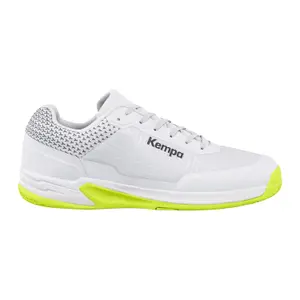


Our page Kempa showcases the handball shoes from the German brand named Bernhard Kempa, who is behind the famous Kempa trick: what they offer in terms of support, cushioning, and grip on the court, how to choose the right size based on your position, and how to maintain them, for players, women players, and young licensees.
A brand born for handball.
Bernhard Kempa, the name behind the brand
Kempa is one of the few sports brands completely focused on handball. It is named after Bernhard Kempa (1920-2017), a figure from Frisch Auf Göppingen and the German team, world champion in handball at eleven in 1952 and 1955. His name is linked to the Kempa trick, a move where a player leaps over the zone, catches a lobbed pass in mid-air, and shoots before landing. The German brand outfits amateur clubs as well as professional teams, and designs its shoes for the specific demands of this indoor sport, involving sprints, jumps, and contact.
The other brands
Handball shoes are also available from:
All shoes can be found on the handball shoes page.
Support, cushioning and grip: the specification
A pair of handball shoes Kempa meets three requirements. First, lateral support: fakes, changes of support and duels put stress on the ankle in all directions, hence reinforcements on the sides of the upper and a firm heel counter. Then, the cushioning, with a foam midsole that absorbs the impacts from jumping shots, repeated dozens of times during a match. Finally, grip, provided by a non-marking rubber outsole that sticks to wooden floors or synthetic surfaces, with a pivot area under the forefoot for turning without locking the knee. The brand offers lightweight models for fast players and more stable models for positions that involve contact.
Shoe size, position and age: choosing your pair Kempa
Indoor shoes should fit snugly, with no movement at the heel, and about half a centimetre in front of the longest toe: a foot that slides in the shoe loses responsiveness and is prone to blisters. Try them on at the end of the day, when the foot has slightly swollen. The position guides the model choice: a winger or a playmaker favours lightness and flexibility for quick starts, while a pivot or a back who takes hits looks for more stability and cushioning. For young players, allow a bit of extra room for growth, but no more than a centimetre, so that the foot is still secured during directional changes.
Good deals
Good bargains can also be found in good deals, promotions, clearance sales, sales, Black Friday. The new arrivals feature the latest collections, and items shipped in 24h are prepared and dispatched within 24 hours. The key events of the year follow a stable order: Black Friday in late autumn, the holiday season, the winter sales, the French Days in spring, then the summer sales and back to school.
Frequently asked questions
Is a Kempa shoe suitable for outdoor handball?
Its soft rubber outsole is designed for wooden and synthetic indoor floors. On an outdoor asphalt court, it wears out quickly and loses its grip: better to reserve your Kempa pair for the indoor court.
How to care for handball shoes Kempa?
Air them out after each session, with the insoles removed, and let them dry away from a radiator. Wipe the outsole with a damp cloth before playing: dust on the floor greatly reduces grip.
When should you replace your handball shoes?
A smooth sole under the forefoot, compressed cushioning that no longer bounces, or a deformed upper that no longer supports the ankle indicate worn-out shoes. For a player training several times a week, this often happens within a season.
High-top or low-top handball shoes: what to choose?
A mid-top upper wraps more around the ankle and provides reassurance after a sprain. A low-top upper, being lighter, allows the ankle to move freely for quick supports; the level of support mainly depends on the lateral reinforcements and lacing.
How to lace your handball shoes for better foot stability?
Use the last eyelet to create a locking loop, then cross the laces through these loops before tying them. The heel stays pressed against the back of the shoe without tightening the upper part of the foot.






