
Men's and women's ski boots


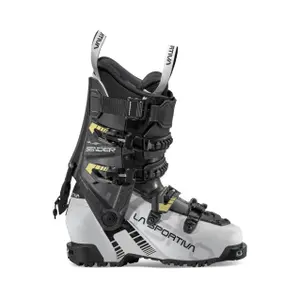
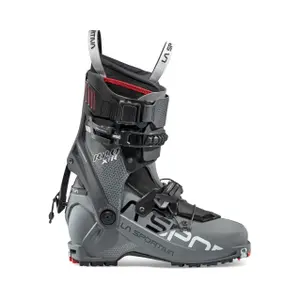
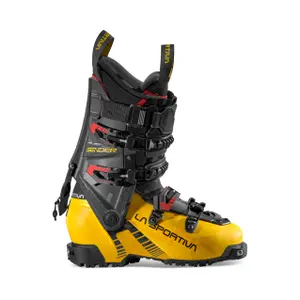
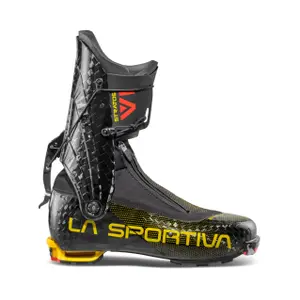


Our selection of ski boots includes alpine boots: Head Nexo LYT, Edge and Formula for women, Head Raptor WCR and Raptor Racing for competition, Roxa R/Fit Pro for women and Dahu Ecorce, the boot with a removable inner boot.
The link between the skier and their skis.
The most important piece
The ski boot is undoubtedly the most important part of your equipment: it’s it that transmits every movement from your foot and leg to the skis. A poorly fitting boot causes pain, cools the foot down, and makes skiing inaccurate. It consists of a rigid shell made of plastic, which transmits pressure, and an inner liner, which ensures comfort and insulation. Choosing one relies on three criteria: size, width, and flex.
Other boots
Winter sports boots also come in:
All boots can be found on the shoes page.
Size, width, and flex
The ski size, in mondopoint, corresponds to the length of your foot in centimeters. The width of the liner at the forefoot, expressed in millimeters, ranges from narrow, precise models for expert skiers and racers to wider, more comfortable options. The flex, a rigidity index, ranges from about seventy for beginners to over one hundred thirty for competitors: a soft boot forgives mistakes and bends easily, while a stiff boot transmits each pressure accurately at high speed. The Head Raptor WCR and Racing, which are very stiff, are designed for racing.
Women, GripWalk, and comfort
Women's boots, like the Head Nexo LYT, Edge, and Formula or the Roxa R/Fit, have a lower and flared cuff, designed for the female calf, and a warmer liner. The GW marking, for GripWalk, indicates a treaded and slightly rounded sole that makes walking around the resort easier; it requires compatible bindings. The Dahu Ecorce, which is original, consists of a soft boot that you walk in normally, and it clips into a rigid exoskeleton for skiing. You dry your liners after each day.
Good deals
Great deals can also be found in the good deals, promotions, clearance, sales, and Black Friday. The new arrivals showcase the latest collections, and items shipped within 24 hours are prepared and sent out in 24 hours. The highlights of the year follow a stable order: Black Friday at the end of autumn, the holiday season, winter sales, French Days in spring, then summer sales and back to school.
Frequently asked questions
What shell stiffness should I aim for according to my skiing level?
The flex measures stiffness: around sixty to eighty for a beginner, ninety to one hundred ten for an intermediate skier, and over one hundred twenty for experts. Women often choose a slightly lower index.
How do I know my ski boot size?
Ski boots are measured in mondopoint, which is the length of your foot in centimeters. Measure your foot while standing, heel against a wall, and choose the corresponding size rather than your street shoe size.
What ski boot is best for a wide foot?
Look at the indicated width of the last in millimeters: around one hundred for an average foot, one hundred two to one hundred four for a wide foot. A thermoformable liner provides even more comfort.
How do I dry my ski boots?
Take the liner out of the shell every evening and let it dry at room temperature or on a gentle air dryer, never on a hot radiator. Close the buckles so that the shell keeps its shape.
What does the removable inner boot of the Dahu provide?
With Dahu, the inner boot comes out of the shell and can be worn like a winter shoe: you can walk comfortably to the slopes or the restaurant, then slide it back into the shell to ski.






