
Halters and leads for Black Friday


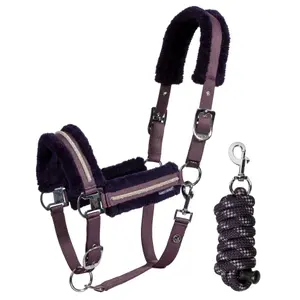


The Black Friday brings together headcollars and leads for leading, tying and showcasing your horse: matching sets Horka, Harry's Horse, Horze and Premiere, padded nylon headcollars, leather headcollars Harry's Horse Supreme and Star for showing, rope headcollar LeMieux Rope Control for ground work, extra strong headcollar QHP and HKM Kids model for shetlands. Durable equipment, from pony to large horse.
Lead and tie your horse safely, at a reduced price.
Nylon, leather or rope: the material of the halter
The halter is used to lead and tie the horse on foot, for grooming, care or transport; it is not ridden with. Its material determines its use. Nylon, often padded at the crown and nape like on the Horka Angel or Harry's Horse Soft sets, is sturdy, easy to wash and comes in all colours. Leather, like on the Harry's Horse Supreme, is more elegant and may give way under very strong pulling, which protects the horse. The rope halter, known as ethological, like the LeMieux Rope Control, is fine and provides precise cues during groundwork.
Other accessories
The horse accessories during Black Friday also include:
All the accessories are gathered on the horse accessories page.
Choosing the size: from shetland to large horse
Halters come in sizes shetland, pony, cob and full, the latter for large saddle horses. The cob fits many medium-sized horses with fine heads. The HKM Kids Maui is tailored for shetlands, the presentation halter Star for ponies. A well-fitted halter places the noseband about two fingers below the cheekbone, without dropping down towards the nostrils where it would obstruct breathing, and allows two fingers to pass between the strap and the head. The headpiece and noseband are adjustable by buckles, enabling fine tuning over the seasons when the coat thickens.
The lead rope: length, material and snap hook
The lead rope generally measures just over two metres: long enough to lead the horse at a safe distance, but not too long to prevent it from getting a leg caught when tied. Made of braided cotton rope, it is soft in the hand and doesn’t burn the palms if the horse pulls; if made from polypropylene or nylon, it dries quickly and withstands the elements. The snap hook, made from brass or steel, attaches to the ring under the jaw. The so-called panic model opens even under tension, by pulling on a sleeve, to free a struggling horse. Matching sets, like the Horze Chicago or the Harry's Horse Love, combine halter and lead rope in the same colour.
Securing your horse safely
Always tie a horse with a safety knot, which can be undone with a simple pull on the free end if the animal panics. The ring should be securely fastened, at about withers height, and the lead rope should not hang lower than the knee. Some stables insert a breakable string between the ring and the lead rope: it breaks before the horse injures itself by pulling back. In the field, a halter left on the head can get caught on a fence; if you must leave one on, choose a model with a breakable headpiece or made of leather, designed to give way. The extra strong QHP halter is suitable for the daily handling of a horse that pulls.
Frequently asked questions
How to clean a nylon halter?
Machine wash it at thirty degrees in a net bag or pillowcase to protect the drum from the metal buckles. Allow it to air dry, then check the seams and buckles, which wear out with sweat and dust.
How to maintain a leather halter?
Wipe off sweat and dust after use with a damp cloth, then condition the leather with grease or balm several times a month. Dry leather can crack and break at the wrong moment, while overly greasy leather attracts dirt.
At what age should a foal wear a halter?
A foal often gets used to the halter in its first weeks, with a model suitable for its small head and very short sessions. Handling it early, gently, makes care, trimming and transport easier later on.
Can you lunge a horse with a halter?
For occasional circle work, a well-fitted halter and a working lead are sufficient, but a cavesson remains more precise and safer, as it does not twist on the head. The rope halter is mainly used for close-up groundwork.
How to tell if a halter is too tight?
If you can no longer slip two fingers under the noseband or headpiece, or if the halter leaves marks or rubbed fur, it is too tight. Loosen it one notch or move to the next size up, especially in winter with the thick coat.






