
Games & pedagogy: motor skills and balance


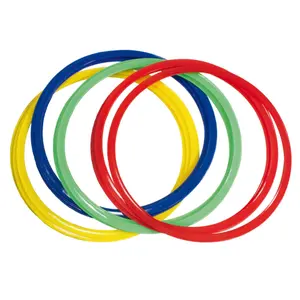

Starting at £46.28
£38.81

Starting at £83.30
£64.36




The Games & Pedagogy page brings together motor skill equipment for schools, leisure centres, and families: slacklines and Giboard boards from Gibbon, bent beam Sporti, flat hoops, footprints on the ground, and orienteering kit SEA, rhythm ladder SKLZ, rhythm balls, and foam structures Softee. Colorful and sturdy equipment that turns exercise into play.
Learning through play, developing balance, coordination, and confidence.
The motor skills course in nursery school
In nursery school, children build their motor skills by acting: walking, running, jumping, crawling, hanging, throwing. The motor skills course links these actions in an order that children read independently using visual cues. The footprints SEA, laid on the ground, indicate where to place each step; the flat hoops Sporti, which don't roll underfoot, mark the areas for jumping with both feet together; the curved beam Sporti, low and stable, compels them to shift their weight along a turning line. The foam structures Softee, ramps, cubes and tunnels add climbs, descents and rolls without risk of injury in case of a fall.
Slackline and Giboard: balance at home
The slackline is a flat strap tensioned between two anchor points, where you move in balance. Gibbon, a German company founded in 2007, popularised the first easy-to-set-up kits between two trees. Its Giboard brings the exercise indoors: a short strap is tightened on a soft wooden board, just a few centimetres off the ground, and the wood's elasticity recreates the swaying of the line. Children can work on balance and concentration without the risk of falling from a height, and the Slackframe frame allows for tensioning a line without a tree.
Related activities have their own page: gymnastics, fitness and climbing.
Rhythm ladder and balls: coordination and balance
The rhythm ladder, a soft ladder laid flat, works on the frequency of foot placements: one foot in each space, then two, sideways steps, lateral jumps. The SKLZ Quick Ladder, with adjustable rungs, allows for spacing to fit the children's size. In class, it also serves as support for counting and rhythm, with each space representing a beat. The rhythmic balls Softee, soft and light, introduce throwing and catching without scaring the little ones; their pearlescent finish catches the eye and helps track their path. The hoop Softee Slalom is finally used to mark doors to pass or targets to aim for, combining movement and accuracy.
The other sports
The other sports on the site, swimming, padel, fishing, roller skating and skateboarding, motorcycling, camping, climbing, golf, fitness, gymnastics, handball, are gathered on the other sports page.
The orientation kit: reading a map from school
The orienteering is part of outdoor physical education activities: students navigate to marked posts on a map, in the yard, a park or a wood. The orientation kit SEA gives teachers what they need to set up a course, with markers placed on the field that students locate with a map in hand. They start with a map of the yard, oriented with the class, before moving to a park map and then to the compass. The activity develops spatial awareness, reading symbols, and cooperation when running in pairs, exchanging the roles of map reader and runner.
Good deals
Good deals can also be found in the good deals, promotions, clearance, sales, Black Friday. The new arrivals showcase the latest collections, and items shipped in 24 hours are prepared and sent within 24 hours. The highlights of the year follow a steady order: Black Friday in late autumn, the end-of-year holidays, the winter sales, the French Days in spring, followed by summer sales and back-to-school.
Frequently asked questions
At what age should you start slacklining?
From four or five years old, a child can walk on a slackline taut at knee height, holding an adult's hand. Balance boards placed on the ground, without the risk of falling, allow for trying it out even earlier.
How do you set up a slackline between two trees?
You choose two trees with a diameter of at least thirty centimeters, protected by straps or cloths, and stretch the line low, without excess. An assistance line taut above serves as a handrail for beginners.
What equipment is needed for PE in primary school?
Hoops, cones, balls of various sizes, and a rhythm ladder cover most sessions. An orientation kit is added for outdoor activities and mats for floor workshops.
What height of beam for a three-year-old?
At this age, the beam stays just above the ground, about ten centimeters at most, and wide enough to place their whole foot. The child ventures on it holding one hand, then alone, before moving on to a narrower or curved beam.
How do you keep children's attention during a workshop?
Short, visual instructions, a demonstration rather than an explanation, and workshops that last just a few minutes rotate. Colorful materials help name the stations: the red hoop, the blue beam, the yellow ladder.






