
Padel Equipment and Game Rules
The padel page brings together the equipment for this racket sport played in doubles on a glass court: solid and perforated rackets, balls, shoes with herringbone soles, clothing, and accessories like overgrips and frame protectors. Head, Nox, Dunlop, or Tecnifibre accompany the beginner discovering the game with the walls just like the tournament player.
An accessible, friendly, and spectacular sport, played by four.
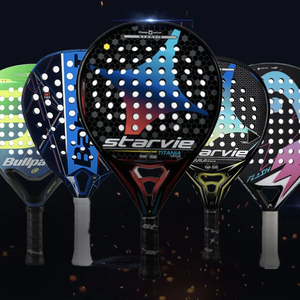
The rules of padel: court, serve and glass
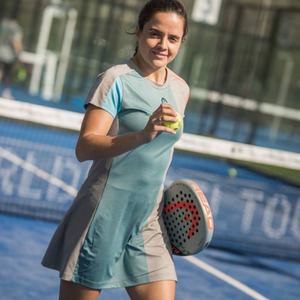
Padel is played in pairs on a court twenty metres long and ten metres wide, enclosed by glass at the back and fencing on the sides, divided by a net eighty-eight centimetres high at the centre. The serve is done underhand: the server lets the ball bounce on the floor, hits it below waist level and must send it diagonally to the opposite service box. During the rally, the ball can hit the glass after bouncing on the floor, which prolongs the points and makes the game accessible from the first match. A ball that hits the opposite glass directly, without bouncing, is considered a fault. The scoring follows that of tennis, in games and sets.
The selection
Padel is organised by type:
Round, drop or diamond: what shape of racket?
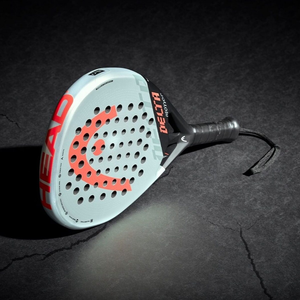
The shape of the racket changes its ideal impact point and balance. A round racket places the centre of gravity near the handle and offers a wide and forgiving hitting area, the best for learning and defending at the back of the court. A drop-shaped racket raises the balance a bit and mixes control with power, a compromise valued by regular players. A diamond racket concentrates the weight at the head for smashes and aggressive volleys, at the cost of a smaller hitting area. Whatever the shape, the international federation's rules limit the racket to forty-five and a half centimetres in length, twenty-six centimetres in width and thirty-eight millimetres in thickness.
Other sports
The other sports on the site, swimming, fishing, roller skating and skateboarding, motorcycling, camping, climbing, golf, fitness, gymnastics, handball, games and pedagogy, are all gathered on the other sports page.
Balls and shoes suitable for synthetic grass
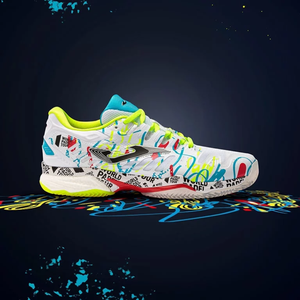
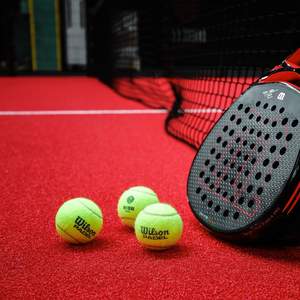
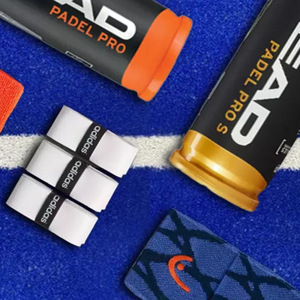
A padel ball is the size of a tennis ball but has slightly lower internal pressure: it bounces lower, which suits the smaller court and playing against the glass. Once the tube is opened, it gradually loses its pressure, and regular players replace their balls every two or three matches, like the three Dunlop tube packs. On the footwear side, padel shoes, like the Head Motion Pro, have a chevron sole that grips the sand without hindering pivots, and a lateral reinforcement that protects the ankle during direction changes. A running shoe, which is too high under the heel and lacks lateral support, risks causing sprains on this surface.
Good deals
Good deals can also be found in the good deals, promotions, clearance, sales, Black Friday. The new arrivals showcase the latest collections, and items shipped within 24h are prepared and sent out in 24 hours. The highlights of the year follow a steady order: the Black Friday at the end of autumn, the holiday season, the winter sales, the French Days in spring, then the summer sales and back-to-school.
Frequently asked questions
Who invented padel?
Its invention is credited to Enrique Corcuera, a Mexican who had a court surrounded by walls built at his home in Acapulco in 1969. The prince Alfonso de Hohenlohe then brought it to Marbella, from where the game spread throughout Spain and then to Europe.
What level do you need to start padel?
No prerequisites: the short racket, without strings, and the less lively ball compared to tennis allow for rallies right from the first hour. Progress then comes from learning to read the bounces on the glass and positioning as a pair.
Padel or tennis: which is easier?
Padel is quicker to pick up: the court is small, the serve is underhand and the glass returns missed balls. Tennis requires more technique to maintain a rally, but the two complement each other well.
How do you hold a padel racket?
The continental grip, with the hand placed on the handle like holding a hammer, is used for almost all shots, from forehand to volley. The wrist strap, attached to the handle, goes around the wrist to ensure you never drop the racket during the rally.
How long does a padel match last?
A court is generally reserved for an hour and a half, enough time to play two or three sets in doubles. In a tournament, the match is played as the best of three sets, with a tiebreaker at six games all.






