
City bike derailleurs
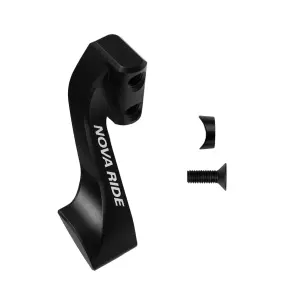

This page dedicated to city bike derailleurs helps you choose, protect, and adjust the part that moves the chain from one cog to another: short or long cage rear derailleur, compatibility with the number of speeds on the cassette and shifter, derailleur guards for bikes parked on the street, and adjustments for smooth shifting every day.
Changing gear, from one light to another.
How a rear derailleur works
The rear derailleur moves the chain sideways from one sprocket to another on the cassette, driven by a cable pulled by the shifter. Its parallelogram guides the arm, which holds two small pulleys: the upper pulley positions the chain under the sprocket, while the lower pulley maintains the tension thanks to a spring. Each click of the shifter corresponds to a specific cable length: this is the principle of indexing.
The derailleur only works when pedalling: when stationary, at a red light, it's impossible to change gears. The right reflex in the city is to downshift just before stopping, to start off in an easy gear without straining your knees.
The transmission
The city transmission also comes in:
The entire transmission can be found on the transmission page.
Number of speeds and transmission compatibility
A derailleur is first chosen based on the number of speeds of the cassette: seven, eight, nine or more, as the gap between two sprockets and the stroke of the shifter depend on it. In the city, seven to nine gears on a single sprocket cover most needs, from starting at a red light to climbing a steep street. The arm must also accommodate the difference between the smallest and largest sprocket: a long arm absorbs larger cassettes and a possible double sprocket, while a short arm is sufficient for a close-ratio setup.
Finally, the mounting method matters: most derailleurs are bolted onto a hanger, while others mount onto the wheel axle using a plate, a common solution on entry-level bikes.
Derailleur guard and everyday adjustments
Parked against a rack, a city bike can fall or be bumped into, and the derailleur, which extends from the frame on the right side, takes the brunt of the impact. A derailleur guard, a metal bracket fixed on the wheel axle, keeps it safe from obstacles. After a fall, it's important to check the alignment of the derailleur hanger: a bent hanger can cause the chain to slip even with a perfect adjustment.
When shifts are hesitant, start by adjusting the cable tension using the barrel adjuster, turning it a quarter turn while rotating the pedals of the raised bike. The limit screws, marked H and L, limit the derailleur's movement so that the chain doesn’t fall off between the cassette and the wheel or against the frame.
Bargains
Good deals can also be found in bargains, promotions, clearance, sales, and Black Friday. The new arrivals showcase the latest collections, and items shipped in 24h are prepared and sent out within 24 hours. The highlights of the year follow a stable order: Black Friday at the end of autumn, the holiday season, winter sales, spring French Days, followed by summer sales and back to school.
Frequently asked questions
Does an electric city bike wear out its derailleur faster?
The extra torque from the motor puts more strain on the chain, cassette, and derailleur, especially if you change gears while applying a lot of pressure. By briefly releasing pressure on the pedals during shifting, you can significantly preserve the transmission.
Is a front derailleur necessary on a city bike?
Rarely: a single sprocket with a cassette of seven to nine gears is sufficient in the city and simplifies usage. A front derailleur is justified on a loaded bike tackling steep hills, with two or three sprockets.
Why does the chain skip without shifting gears?
Most often, the cable has loosened or the derailleur hanger was bent by an impact. A worn chain and cassette can also cause these skips: the chain's elongation should be measured with a wear indicator before making any adjustments.
How do you clean a derailleur after rain?
Wipe the arm and pulleys with a cloth, then remove any mud caught between the pulleys with a brush. A drop of lubricant on the joints of the parallelogram, then wiped off, prevents corrosion and hard shifts.
When should a city bike derailleur be replaced?
When the parallelogram has play, the pulleys are worn flat, or the arm remains bent after an impact. If the adjustment doesn’t hold despite a new cable and housing, the derailleur has probably reached the end of its life.






