
Golf putters for boys
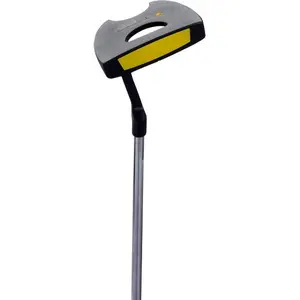
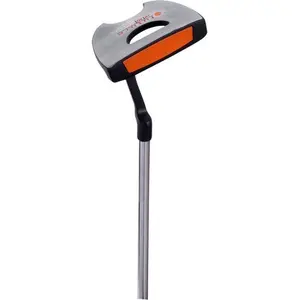
This page is aimed at parents and young players looking for golf putters for boys: suitable length for height, choice between blade and mallet head, grip hold and green rules. Our tips support the child from their first putts at golf school to youth competitions, where the short game often makes the difference on the scorecard.
On the green, precision is key.
What length putter according to the boy's height
The right length is checked in position: feet shoulder-width apart, torso bent from the hips, with the eyes over the ball and arms hanging without tension. The top of the grip should then fall into the hands without the child crouching or standing up straighter. Junior clubs are classified by height range rather than by age, as two ten-year-old boys can have a twenty-centimetre difference. A cut-down adult putter is not recommended: its head remains heavy for a shortened shaft, the balance is off, and the stroke becomes jerky. When the child has grown by about ten centimetres, the test is repeated.
The rest of the bag
Boys' clubs also come in:
All clubs are compiled on the boys' clubs page.
Blade or mallet head: which for a young player
The blade head, thin and compact, provides precise feedback and is suitable for boys whose swing follows a slight arc. The mallet head, wider and deeper, places more weight away from the face: it spins less on an off-centre impact, and its sight lines help to align the face to the target. For a beginner, the mallet often provides reassurance; a more advanced player will choose according to their swing. The grip also matters: the putter is the only club allowed to have a non-round grip, flattened on top, to rest both thumbs and keep the face perpendicular to the line of play.
The putting rules explained to young golfers
Some rules directly concern the putter. Since 2016, it is prohibited to anchor the club against the body, belly or chest, during the stroke: the movement must remain free, prompting learning a shoulder pendulum from an early age. Since 2019, a player can leave the flag in the hole while putting, a time-saver appreciated during junior games. On the green, one can mark, lift, and clean their ball, and repair ball or shoe marks on their line. Knowing these rules avoids penalties in competition and gives the boy confidence on the green.
Good deals
Good deals can also be found in the good deals, promotions, clearance, sales, Black Friday. The new arrivals feature the latest collections, and items shipped in 24h are prepared and dispatched within 24 hours. The highlights of the year follow a stable order: Black Friday at the end of autumn, the end of year holidays, winter sales, French Days in spring, followed by summer sales and back-to-school.
Frequently Asked Questions
How to hold a putter when starting out?
The palms face each other on either side of the grip, with the thumbs laid flat on top. The pressure remains light, like holding a bird without choking it: tensed hands restrict the shoulders and make the stroke inconsistent.
At what age can a boy have his own putter?
As soon as he hits his first balls, around four or five years old, a putter sized for him helps establish good habits. A club that is too long forces him to stand up straighter and hit with his wrists, a flaw that is hard to correct later.
How to practice putting at home?
A mat or a hallway is enough: aim for a glass lying on its side or a coin, one or two metres away. Hitting ten putts in a row before stepping back makes the exercise fun and improves the consistency of the pendulum.
How to judge the strength of a long putt?
The distance is adjusted by the amplitude of the swing, not by a sharp hit: the backswing and follow-through should be the same length, at a constant rhythm. Practising on three targets placed at different distances helps to memorise the feel.
How to read the slope of a green?
Look at the green on arrival, when the terrain is easier to see from a distance, then squat down behind the ball. The ball will break towards the lowest side: aim above the hole, especially as the putt is slow.






