
Badminton shuttlecocks on clearance
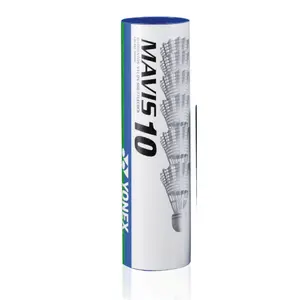
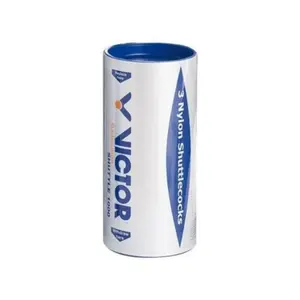
The clearance sale of badminton shuttles brings together end-of-line tubes for club and leisure use: feather shuttles Yonex Aerosensa for competitions, nylon shuttles Yonex Mavis, Victor Nylon and Wilson Smashstar for training, shuttles Victor and NILS Extreme. Feather or synthetic, speed suitable for indoor use, tubes of three to twelve shuttles: every player can find one that fits their game.
The right shuttle for every session, at a discounted price.
Feather, nylon or hybrid: three types of shuttlecocks
The feather shuttlecock has sixteen goose or duck feathers attached to a cork base covered with leather: it's the competition shuttlecock, with a natural flight and a sharp deceleration at the end of its path. The Yonex Aerosensa belongs to this category. The nylon shuttlecock, like the Yonex Mavis or Victor Nylon, replaces feathers with a single-piece synthetic skirt: it lasts much longer and forgives off-centre hits from beginners. The hybrid shuttlecock combines a cork base and a synthetic skirt to mimic the flight of the feather. The regulations set the weight of a shuttlecock between 4.74 and 5.50 grams.
Other end-of-line products
The badminton clearance also includes:
All end-of-line products are gathered on the badminton page.
Choosing speed based on the temperature of the hall
The speed of the shuttlecock is chosen based on temperature and altitude: warm air, being less dense, allows it to travel further, while cold air slows it down. For nylon shuttlecocks, the colour of the band indicates the speed: green for slow flight in a warm hall, blue for medium speed, red for fast flight when it’s below about thirteen degrees. For feather shuttlecocks, speed is indicated by a number, usually between seventy-six and seventy-nine. The regulations provide a test: struck from below from the baseline, a shuttlecock of the correct speed falls between fifty-three and ninety-nine centimetres before the opposite baseline.
Lifespan and storage of feather shuttlecocks
A feather shuttlecock deteriorates with each smash: one broken or bent feather is enough to make its flight unstable, and it must then be removed from play. To limit damage, tubes are stored in a cool place, away from the dry air of heating, which makes the feathers brittle; some clubs place tubes in a humid room the night before a tournament. The shuttlecocks are taken out from the side of the cork, without pulling on the feathers. The goose feather, thicker and more flexible, lasts better than the duck feather, hence the difference in durability between ranges. Nylon shuttlecocks avoid these constraints and are suitable for beginner sessions and school sports.
From leisure to competition: which shuttlecock for which player
The leisure player, who plays with family or friends, finds the best balance between durability and feel in the nylon shuttlecock: a tube of six lasts through many sessions. The club player preparing for matches must get used to the flight of the feather, which is faster at the start and slows down later, affecting how they play drops and clears. In official competitions, the federation requires certified feather shuttlecocks. For the shuttlecocks thrown by the coach, many clubs recycle slightly used but still playable feather shuttlecocks. Tubes of twelve, like the Aerosensa, are suitable for this collective use.
Frequently Asked Questions
How long does a nylon shuttlecock last?
Depending on the intensity of play, a nylon shuttlecock lasts several sessions, whereas a feather shuttlecock may become unusable after just one match. It should be replaced when the skirt cracks or deforms and the flight becomes floating.
Can you play outside with indoor shuttlecocks?
The wind strongly deflects a standard shuttlecock, whether it's feather or nylon. To play outside, prefer a nylon shuttlecock, which is sturdier, and a day with no wind: the feather, light and fragile, is reserved for indoor play.
How do you recognise a good quality shuttlecock?
The feathers are aligned, of equal length and firmly glued, the base is well-rounded and covered with leather. In flight, a good shuttlecock spins itself smoothly without wobbling and always lands in the same spot for a consistent hit.
What shuttlecock for a beginner child?
A nylon shuttlecock is robust enough to withstand off-centre hits and drops to the ground without deforming. Shuttlecocks with a blue band, for medium speed, are suitable for most school gyms, neither too warm nor too cold.
Why does a feather shuttlecock spin itself?
The feathers overlap in the same direction, causing the shuttlecock to spin around its axis during flight. This rotation stabilises the trajectory and explains why a single damaged feather is enough to make it wobble.






