
BMX Brake Cables and Housings

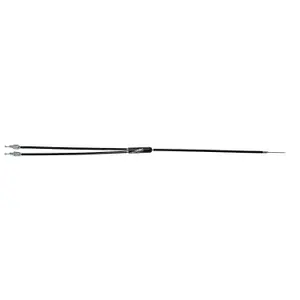


Our selection of BMX Brake Cables and Housing includes the upper cable Odyssey Gyro for rotor, along with our tips for setting up your rear brake, fitting a rotor that allows for handlebar rotations, adjusting tension, and maintaining your brake control in street and park.
A brake that follows every rotation.
The rotor cable
In freestyle, the rotor, or gyro, allows the handlebars to rotate three hundred and sixty degrees without tangling the brake cable, to perform tailspins and barspins. It uses two cables: a top cable that connects the lever to the rotor via a separator, and a bottom cable that runs down to the brake caliper. The Odyssey Gyro top cable, from a pioneering rotor brand, fits this setup.
The rest of the braking
BMX braking also comes in:
All braking information is gathered on the braking page.
Installing and adjusting
The rotor needs careful adjustment: both strands of the top cable must have the same tension so that the rotor plate remains parallel and the handlebars can turn freely. An unbalanced adjustment causes spongy braking or a rotor that catches. Adjust using the adjustment knobs, then check the tightness of the caliper on the pads.
Or without brakes
Many street riders today ride brakeless for a cleaner and lighter bike, controlling their speed with their foot on the tyre. In skateparks, and for beginners, a rear brake remains a real safety asset. The cable and its sheath wear over time: a frayed cable or a split sheath should be replaced without delay.
The good deals
Good deals can also be found in good plans, promotions, clearance, sales, Black Friday. The new arrivals feature the latest collections, and the items shipped in 24h are prepared and dispatched in 24 hours. The highlights of the year follow a steady order: the Black Friday at the end of autumn, the holiday season, the winter sales, the French Days in spring, then the summer sales and back to school.
Frequently asked questions
How does a rotor work on a BMX?
The rotor distributes the brake force between two top cables connected by a separator, allowing the handlebars to turn endlessly without tangling the cable. The bottom cable then transmits the force to the rear caliper.
How to adjust the brake cable tension on a BMX?
First, adjust both top cables to ensure the separator stays level, then adjust the tension using the knobs on the lever and caliper, until the braking is firm without the pads rubbing.
Is riding brakeless on a BMX a good idea?
Many street and park riders go without brakes for a cleaner bike without annoying cables. This is not recommended for beginners and in urban traffic, where the rear brake remains an essential safety feature.
When should you change a BMX brake cable?
Change it as soon as it frays, rusts, or slips badly in its sheath, and after a fall that bends it. A cable that rubs makes braking less precise and can fail at the wrong moment.
What sheath to choose for a BMX brake?
Choose a spiral brake sheath, which is more resistant to compression than a derailleur sheath. Cut it cleanly to the right length, with end caps fitted, so that the handlebars can turn without pulling on the cable.






