
MTB Pedals and Bottom Brackets


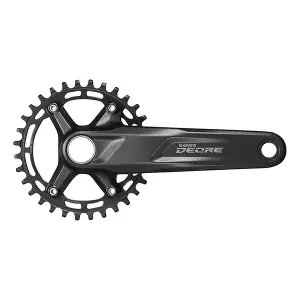


Our selection of MTB Cranksets includes the twelve-speed single-chainrings Shimano Deore XT and SLX, the double and triple Shimano Acera, Altus, and Tourney for touring, the widened Sram NX Eagle for fat bikes, the oval crankset Krayton, and the Prowheel, as well as the bottom brackets Shimano and Enduro that fit them.
The rider's strength, transmitted to the trail.
Single chainring, double or triple on a mountain bike
The single chainring has become popular on cross-country, trail, and enduro mountain bikes: a single chainring with alternating narrow and wide teeth, holding the chain without a guide, paired with a twelve-speed cassette with a wide range. The Shimano Deore XT and SLX follow this principle, with Hollowtech II hollow crankarms and an interchangeable direct mount chainring. The doubles and triples Acera, Altus, and Tourney remain relevant on touring and leisure mountain bikes: their small chainring offers very low gears for climbing with a load, and the reduced gap between sprockets makes pace changes smoother on long rides.
The drivetrain
The mountain bike drivetrain also comes in various forms:
All drivetrain information is available on the drivetrain page.
Chain line, Boost and fat bike
The chain line, the distance between the frame's bottom bracket and the chainring, must match the rear hub spacing. Boost frames, with a rear hub of one hundred forty-eight millimeters, shift the chainring outward; an unsuitable crankset makes the chain run at an angle and increases drivetrain wear. The extreme case is the fat bike: its four-inch tires require hubs from one hundred seventy to one hundred seventy-seven millimeters, and the Sram NX Eagle fat bike pushes the chain line out to sixty-six and a half millimeters thanks to an extended DUB axle and a thirty-tooth direct mount chainring. The spacing between the pedals increases accordingly.
Square axle, Hollowtech II or press-fit: the bottom bracket
Three types of bottom brackets are found on mountain bikes. The square axle bottom bracket, a sealed cartridge screwed into the frame, like the Shimano model in our selection, is for entry-level cranksets like the Tourney; it needs to be replaced as a whole when it wears out. The Hollowtech II standard places the bearings outside the shell, around a twenty-four millimeter axle fixed to the right crankarm, for Deore XT and SLX. Press-fit frames use inserted cups: the Shimano bottom bracket of forty-one millimeters fits shells of eighty-nine and a half or ninety-two, while the Enduro TorqTite works with BBright frames.
The good deals
Good deals can also be found in the good plans, promotions, clearance, sales, and Black Friday. The new arrivals feature the latest collections, and items shipped in 24h are prepared and sent within 24 hours. The highlights of the year follow a steady order: Black Friday in late autumn, the year-end holidays, the winter sales, the French Days in spring, then the summer sales and the back-to-school season.
Frequently asked questions
What is the purpose of an oval chainring on a mountain bike?
The oval chainring provides a larger gear when the leg pushes hard and a smaller one in the dead spots. On climbs, traction becomes more consistent, and the rear wheel slips less: this is the principle behind the oval chainring Krayton.
How to remove a mountain bike crankset?
On a Hollowtech II, loosen the two bolts on the left crankarm, remove the preload cap, then the right side axle. A square axle crankset requires a puller screwed into the crankarm after removing the central bolt.
What size chainring to choose for a single chainring setup?
A chainring of thirty or thirty-two teeth suits most trail riders. A smaller chainring makes steep climbs easier and helps at altitude, while a larger one favors speed on rolling terrain.
What crankarm length to choose for a mountain bike?
Most adult mountain bikes are fitted with one hundred seventy or one hundred seventy-five millimeter crankarms. A shorter crankarm provides more ground clearance on low full-suspension bikes and reduces pedal strikes in rocky conditions.
What needs to be changed to eliminate the front derailleur?
Yes, but the conversion goes beyond just the crankset: a wide-range cassette, a long-cage rear derailleur, and compatible shifters are needed. The rear hub must also accommodate the freehub body of the chosen cassette.






