
Automatic road bike pedals


Starting at £73.37
£62.96





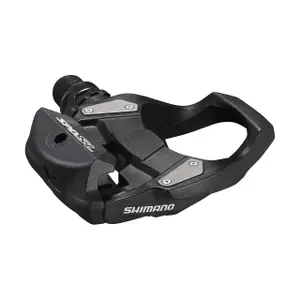
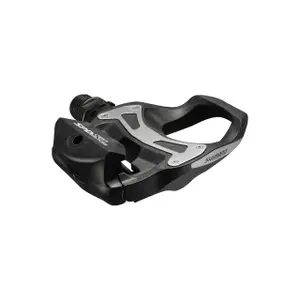
Our selection of road bike pedals includes the Look Keo Blade Ceramic and Keo Max, the Shimano SPD-SL and the dual-sided Shimano pedal, the Favero Assioma Uno and Duo, and the Magene power meter pedals, as well as the P2R platform pedals and their resin adapters for riding in trainers. These systems are chosen for power transfer and reliable unclipping.
Every watt goes to the road.
Look, pioneer of the automatic pedal
The automatic road pedal comes from skiing: Look, a company from Nevers specialising in bindings, transferred its expertise to cycling in the mid-1980s. In 1985, Bernard Hinault won the Tour de France with the La Vie Claire team using these pedals, and the peloton soon abandoned strap pedals. The Keo range, launched in 2004, is its successor: on the Keo Blade, a carbon blade replaces the spring and fixes the release tension, while the Keo Max features a wide platform and a tension adjustable by screw. The Ceramic version adds ceramic bearings to reduce friction.
Other components
Road components are also available:
All components can be found on the peripheral components page.
Power sensor: Favero Assioma and Magene
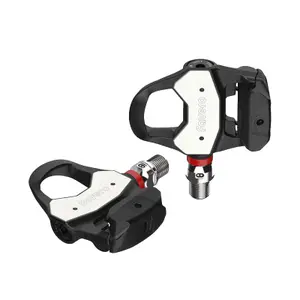
A power sensor pedal measures the force applied and the cadence, then transmits the watts to the meter. At Favero, the electronics of the Assioma are housed in an end-of-axle casing rather than in the pedal body: in the event of a fall, only this body, which can be replaced without special tools, absorbs the impact. The Assioma Uno measures the left leg and extrapolates the total value, while the Duo measures each leg and reveals imbalances; a Uno can upgrade to a Duo at any time. The Magene models come in a compatible version with Look Keo or Shimano SPD-SL cleats, to keep your shoes and usual settings.
SPD-SL, mixed pedal and P2R adapters
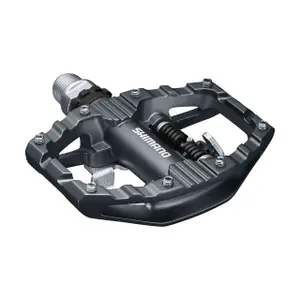
The Shimano SPD-SL system, a major rival of the Keo, also relies on a three-screw cleat. Its cleats can be recognised by their colour: yellow with six degrees of freedom, blue with two, red with no play, unlike Look, where the red cleat has the most freedom. For touring, the mixed pedal Shimano combines an automatic SPD side, with a small cleat embedded in the sole, and a flat side for street shoes. The adaptors P2R made from resin clip onto a Look or Shimano pedal for trips in trainers, and the P2R pedals with toe clips and straps are suited for tracks and vintage bikes.
Good deals
Great finds can also be found in the good deals, promotions, clearance, sales, Black Friday. The new arrivals showcase the latest collections, and items shipped in 24h are prepared and dispatched within 24 hours. The key events of the year follow a stable order: the Black Friday in late autumn, the year-end holidays, the winter sales, the French Days in spring, followed by the summer sales and the back-to-school season.
Frequently Asked Questions
Look Keo or Shimano SPD-SL pedals: how to decide?
Both offer a large support surface and excellent power transfer, but their cleats are not compatible. The choice is often based on the cleats already fitted to one's shoes, or depending on the desired power sensor, with the Assioma using the Keo standard.
How to adjust the release tension?
On most pedals, a screw at the back of the mechanism tightens or loosens the hold. Start with a loose setting, then gradually tighten if the foot releases unintentionally during sprints. On the Keo Blade, you change the blade to adjust the tension.
How to position the cleats under the shoe?
The pedal axle should go under the widest part of the forefoot, and the cleat should follow the foot's natural angle, which is often slightly open. Adjust in small increments: a cleat badly positioned can lead to knee pain.
How to get started with automatic pedals?
First practice while stationary, leaning against a wall, then on a parking lot without traffic. The release is done by rotating the heel outward, which should be anticipated as you approach each stop by freeing a foot early.
What is the battery life of Favero Assioma pedals?
Favero announces about fifty hours of use per charge, with a built-in battery that charges via a magnetic cable. A signal warns a few hours before the battery runs out, giving you time to finish your ride.






