
Road bike cranksets


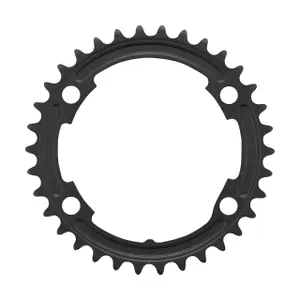


Our selection of Chainrings for road bikes includes Shimano Dura-Ace, Ultegra and Tiagra chainrings, both inner and outer, for ten to twelve speed drivetrains, the double Rotor direct mount chainring in forty-six and thirty teeth, as well as Sunrace, Prowheel and Kellys chainrings, along with our advice on tooth count, bolt circle diameters and compatibility.
The right gear ratio, right from the crankset.
Compact, semi-compact or standard: which chainring
On the road, the double chainset comes in three combinations. The standard, fifty-three and thirty-nine teeth, is aimed at powerful riders and flat courses. The semi-compact, fifty-two and thirty-six teeth, has become the most versatile choice for cycling enthusiasts. The compact, fifty and thirty-four teeth, makes climbing easier. For even easier climbs, the double chainset Rotor with direct mount, featuring forty-six and thirty teeth, offers a very short gear ratio, appreciated by touring cyclists in the mountains: when paired with a wide cassette, it tackles the steepest slopes at a comfortable cadence.
The transmission
The road transmission also includes:
All the transmission components are gathered on the transmission page.
Bolt spacing, position and number of speeds
A chainring must first correspond to the crankset. At Shimano, recent road cranksets, Dura-Ace, Ultegra and Tiagra, use four arms and a bolt spacing of one hundred and ten millimetres, but the shape and drilling change from generation to generation: the crankset reference is engraved on the back of the arm. Each chainring is designed for a specific position, either inner or outer, and a given tooth count; the large chainring has an anti-jam pin that should be placed behind the crank arm. Finally, the profiles of the teeth and the ramps differ between ten, eleven, and twelve speeds: it is important to respect the number of speeds of the transmission.
Identifying a worn chainring and mounting it correctly
A worn chainring is identified by its teeth worn down on one side, shaped like waves or shark fins, and by a new chain that slips or catches under load. An elongated chain accelerates this wear: its elongation is measured with a wear indicator, and it should be replaced in time, ensuring that a well-maintained chainring can outlast several chains. When mounting, lightly grease the screws, tighten them in a criss-cross pattern to the torque specified by the manufacturer, and then check the height and alignment of the front derailleur, which should graze the large chainring without touching it.
Good deals
Good deals can also be found in the good deals, promotions, clearance, sales, Black Friday. The new arrivals showcase the latest collections, and items shipped in 24h are prepared and dispatched within 24 hours. Key events of the year follow a stable order: the Black Friday at the end of autumn, the holiday season, the winter sales, the French Days in spring, then the summer sales and back to school.
Frequently asked questions
Which chainring to choose for mountain riding?
The compact, fifty and thirty-four teeth, is the go-to option for climbs. Paired with a cassette having a largest cog of over thirty teeth, it allows for comfortable climbing; even shorter doubles relieve loaded touring cyclists.
Can you mount a chainring from another brand on a Shimano crankset?
This is possible if the bolt spacing, number of arms and shape match, which is rarely the case on recent four-arm Shimano cranksets. Therefore, original chainrings are preferred, as their ramps are set for the front derailleur.
Is an oval chainring interesting for road cycling?
The oval chainring varies the gear ratio during the pedal stroke: larger during the push phase, smaller at dead spots. Some find it improves smoothness when climbing, while others see no benefit: trying it remains the best judge.
How to calculate the gear ratio of a setup?
You divide the number of teeth on the chainring by that on the cog, then multiply by the wheel's circumference, just over two metres for a road tyre. A fifty on eleven thus gives nearly nine and a half metres per pedal stroke.
What does the inscription BCD on a chainring mean?
The BCD, for bolt circle diameter, is the diameter of the circle passing through the mounting screws, in millimetres. It must match that of the crankset: one hundred and ten millimetres on most recent road double chainrings, one hundred and thirty on older standards.






