
Road bike pedals


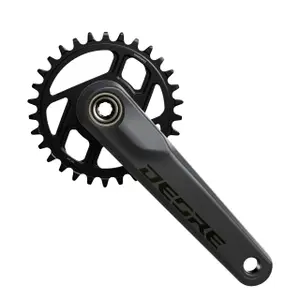
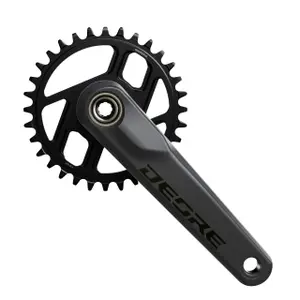


Our selection of Road Cranksets includes the double chainring crankset Sram Red AXS with a DUB axle and the accompanying bottom brackets: Shimano Hollowtech II threaded, Black Bearing in T47 or GXP, Enduro TorqTite and Nova Ride in BB386, along with our advice on gear ratios, crank arm length and frame standard.
Transmit every watt.
Compact, semi-compact or standard: road chainrings
On the road, the double crankset remains the standard, and its gearing defines the character of the bike. The compact, with fifty-three-thirty-four teeth, makes it easier for climbing and rolling terrain; the semi-compact, with fifty-two-thirty-six, covers most sports rides; the standard, with fifty-three-thirty-nine, targets powerful riders. The Sram Red AXS follows a different logic, with closer ratios: fifty-three-thirty-seven, forty-eight-thirty-five or forty-six-thirty-three teeth, paired with twelve-speed cassettes starting at ten teeth. Its hollow carbon crank arms feature direct mount chainrings, without an intermediate spider.
The drivetrain
The road drivetrain also comes in these options:
All of the drivetrain information can be found on the drivetrain page.
What crank length based on your physique
The crank length is measured from the pedal axle to the bottom bracket axle. On the road, the range goes from one hundred sixty to one hundred seventy-five millimeters, and the Sram Red AXS comes in this full range. A longer crank provides more leverage but increases knee flexion at the top of the pedal stroke; a shorter crank opens the hip angle, facilitates a lower position and a higher cadence. Many average-sized cyclists ride with one hundred seventy-two and a half millimeters as a habit, while smaller riders often benefit from going down to one hundred sixty-five or less. Changing crank length requires raising or lowering the saddle accordingly.
Threaded, press-fit or T47: compatibility
The crankset rotates within a bottom bracket that must be compatible with both the frame and the axle. For the frame, the BSA threaded bottom bracket of sixty-eight millimeters remains the easiest to maintain; the press-fit, like the BB86 or BB386, fits the bearings tightly; the T47, threaded but wider, combines both advantages and fits newer frames. On the axle side, Shimano uses a diameter of twenty-four millimeters, Sram uses the DUB axle of just under twenty-nine millimeters, and the older GXP has a stepped axle. The threaded Shimano Hollowtech II bottom bracket serves BSA frames, while Black Bearing, Enduro TorqTite and Nova Ride connect a frame to an axle of a different standard.
Good deals
Good deals are also found in the good deals, promotions, clearance, sales, and Black Friday. The new arrivals showcase the latest collections, and items shipped in 24 hours are prepared and dispatched within that time frame. The highlights of the year follow a predictable pattern: the Black Friday at the end of autumn, the year-end holidays, winter sales, the French Days in spring, then the summer sales and back to school.
Frequently asked questions
How to remove a road bike crankset?
On a Shimano Hollowtech II, loosen the two bolts of the left crank arm, remove the cap with its tool, then pull the axle out on the right side. On a Sram DUB, the bolt of the left crank arm acts as an extractor: by unscrewing it, it pushes the crank arm out of the axle.
What is the lightest road crankset?
The lightest cranksets combine hollow carbon crank arms, an aluminium axle and chainrings mounted directly to the crank arm. The Sram Red AXS follows this principle; however, the rigidity and precision of the gear changes count just as much as the grams.
Is a single chainring a good idea on a road bike?
The single chainring removes the front derailleur but increases the gaps between cogs, which can be an issue in a group when seeking the ideal cadence. On the road, the double chainring still has the advantage for following changes in pace.
When should a bottom bracket be replaced?
A creaking sound with each pedal stroke, lateral play in the crank arm or rough rotation with a free axle indicate worn bearings. On a cartridge bottom bracket, the whole assembly is replaced; on some removable models, only the bearings are changed.
Does a double crankset work with any front derailleur?
The front derailleur must accommodate the tooth difference between the two chainrings and the number of speeds in the drivetrain. A Sram Red AXS crankset is operated with an electronic front derailleur from the same family, without a cable.






