
Road bike transmission


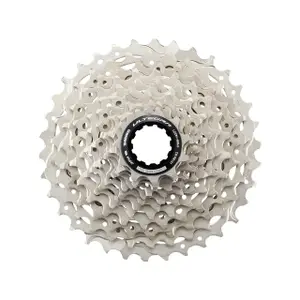
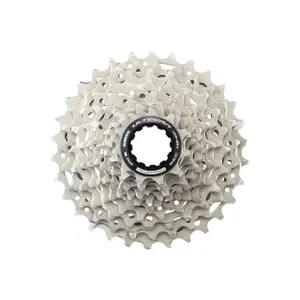
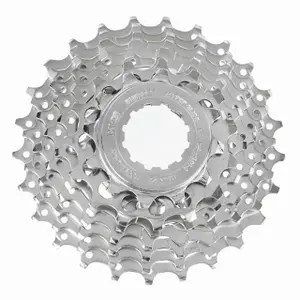

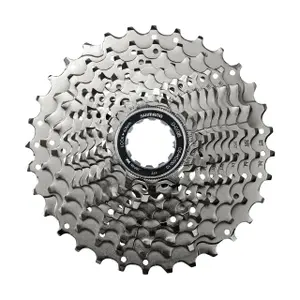





This page brings together the parts of the road bike drivetrain: cranksets, chainrings, cassettes, bottom brackets, and shifters, from Shimano, SRAM, Rotor, Stronglight, Miche, or XLC. It is aimed at the cyclist who is replacing a worn part as well as those who want to adjust their gearing for climbs, from a compact crankset to a triple touring chainring, while ensuring compatibility between speeds and frame standards.
The mechanical heart of the bike, the one that transforms every pedal stroke into speed.
From Claris to Dura-Ace: the hierarchy of road groups
A road group is primarily chosen based on its level. At Shimano, the range starts with Claris at eight speeds, moving through Sora at nine and Tiagra at ten, before reaching 105, Ultegra, and Dura-Ace, launched in 1973 for competition. Upgrading the range lightens the components, shortens gear shifts, and improves the ergonomics of the levers.
At SRAM, Apex, Rival, Force, and Red share the wireless technology AXS: each shifter communicates wirelessly with the derailleurs, powered by their own battery. Shimano counters with Di2, also electric, with derailleurs that draw power from a battery located in the frame.
Compact, semi-compact or triple: which chainrings for the terrain
The size of the chainrings fixes the gear range, even before the cassette. The compact crankset, with 50 and 34 teeth, maintains a smooth cadence on steep climbs; the semi-compact, with 52 and 36, is fitted on most current racing bikes; the 53 and 39 is for powerful riders. For loaded touring, the triple chainring Stronglight, with 52, 42, and 30 teeth, offers a low gear that no double can provide.
The round chainrings Rotor in 46 and 30 teeth, with direct mounting on the crank, are aimed at high mountains. Lastly, the crank length, from 165 to 175 millimeters, is chosen based on the inseam length.
Bottom bracket: threaded or press-fit depending on the frame
The bottom bracket is chosen based on the frame, not just the crankset. A threaded frame with the BSA standard, 68 millimeters wide for road use, uses screw-in cups with external bearings, like the Shimano Hollowtech bottom bracket, which can be removed with a simple tool. A press-fit frame, for example BB86, uses bearings pressed into the bottom bracket shell.
It's also important to match the axle diameter: 24 millimeters for Shimano, the DUB standard at 28.99 millimeters for SRAM. The Black Bearing bottom brackets with SKF bearings can for example accommodate a GXP axle crankset in a BB86 or BB92 press-fit frame.
The selection
The transmission is organised by piece:
- Groups, complete.
- Cranksets.
- Chainrings.
- Cassettes and Chains.
- Derailleurs.
- Gear shifters.
- Cables and Housing.
The road bike is complemented by bikes, brakes, wheels and tyres, components, equipment, on the road page.
Cassette and number of speeds: compatibility rules
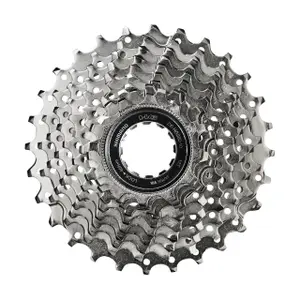
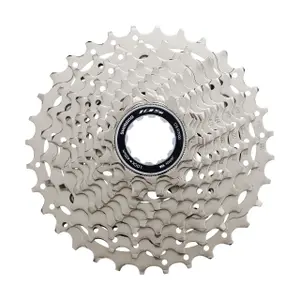
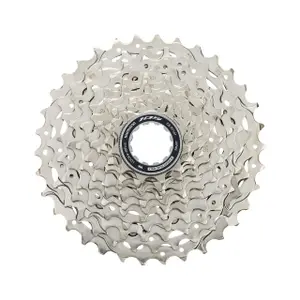
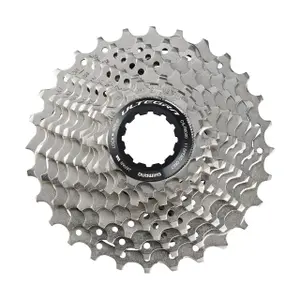
A cassette only works with a chain and shifters of the same number of s peeds, and on an appropriate freehub body. The Miche cassette with eight speeds, in 13 to 26 teeth, is designed for Campagnolo hubs; the XLC cassette with ten speeds, in 13 to 28, follows the Shimano spacing. The Shimano eleven-speed cassettes require a longer road hub body than the older ones: a spacer fills the gap when fitting a ten-speed.
The largest cog dictates the rear derailleur: a 32 or 34-tooth cog often requires a long cage, capable of accommodating the extra chain length.
Frequently asked questions
Electronic or mechanical transmission: which to choose for road?
Electronic shifts each gear with the same precision, without needing to tension cables, but relies on a battery that needs charging. Mechanical systems can be repaired on the roadside with a simple cable, an advantage for long-distance touring and tight budgets.
When should you replace a road bike chain?
You measure its elongation with a wear indicator: at half a millimetre per link on an eleven or twelve-speed transmission, it’s time to change it. Waiting longer damages the cassette and chainrings, which would then need to be replaced with it.
Can you mix Shimano and SRAM parts on a road bike?
The eleven-speed chains and cassettes from both brands share the same pitch and usually work together without issues. However, the shifters and derailleurs pull the cable differently and should be kept within the same brand.
What gear ratio should you choose for climbing a hill on a road bike?
For an amateur cyclist, a small chainring of 34 teeth paired with a 32 or 34-tooth cog keeps a steady cadence on long climbs. Experienced climbers can manage with a 36 and a 30-tooth cog.
How do you maintain the transmission of a road bike?
After a wet ride, wipe down the chain, then degrease it regularly before applying a drop of lubricant to each roller. Then remove the excess, which would attract dirt and wear out the cogs and chainrings more quickly.






