
Children's bike tyres
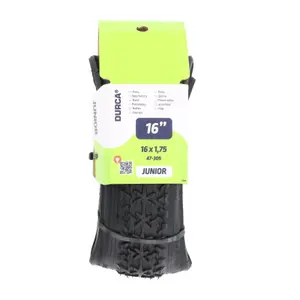
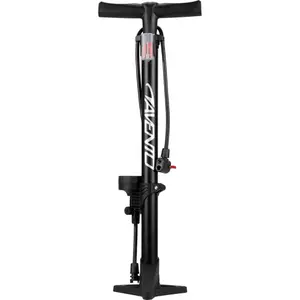
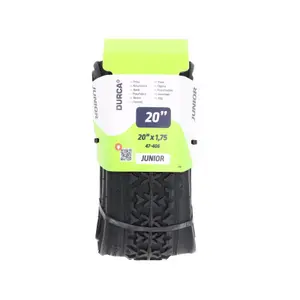
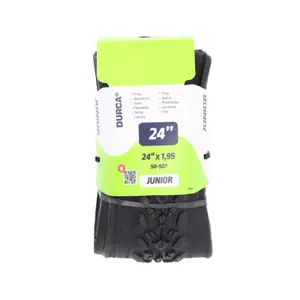
Our kids' bike tires page brings together the Durca tire with flexible beads and our tips for choosing the right cover: understanding the ETRTO size, pitfalls of fourteen inches, smooth or knobbly tread, pressure suited for a lightweight cyclist, and checking for wear. A good tire makes the little bike easier to pedal and safer on the pavement as well as in the park paths.
The right tire for riding with confidence.
Reading the size on a child's tyre
The size is read on the sidewall of the tyre in two forms. The designation in inches, like sixteen by one point seventy-five, gives the approximate diameter and width. The ETRTO code, like 47-305 for the same tyre, shows the width in millimetres then the exact diameter of the rim: that's what you should refer to. A twenty-inch by one point seventy-five corresponds to 47-406, a twelve-inch to a rim of 203. The fourteen-inch requires special attention: it exists in a rim of 254 and in a rim of 288, the latter linked to fourteen-inch tyres by one and three eighths, like the 37-288. The two are not interchangeable.
Other tyres
Tyres also come in the following types:
All tyres can be found on the tyres page.
Flexible or rigid beads: what changes with the Durca
The beads are the two circles that hold the tyre onto the rim. On the Durca tyre, they are flexible: the tyre folds for transport and weighs less than a model with steel beads. For a child, who pedals with a lightweight body, reducing the weight of the wheels makes every push-off easier, especially when starting from a stoplight or on a slight hill. The flexibility also makes mounting onto a small rim easier, which can often be difficult with a rigid tyre: the tyre can be put into place by hand, without a lever that might pinch the inner tube.
Profile and pressure for a lightweight cyclist
The profile is chosen according to the terrain: a lightly treaded tyre rolls easily on tarmac and cycle paths, while a treaded profile grips in grass, dirt, and gravel on paths. The pressure, it, depends on weight: the range indicated on the sidewall, in bar and PSI, is calculated for an adult load, and a lightweight child rides well in the lower part of this range for more grip and comfort. You should never go below the minimum, or you risk pinch flats against the rim. Checking with a pressure gauge pump every week avoids surprises.
Good deals
Good bargains can also be found in the good deals, promotions, clearance, sales, and Black Friday. The new arrivals showcase the latest collections, and the items shipped within 24h are prepared and sent out in 24 hours. The key events of the year follow a stable order: Black Friday in late autumn, the end-of-year festivities, the winter sales, the French Days in spring, then the summer sales and back-to-school.
Frequently asked questions
How many bars should be put in a child's bike tyre?
The pressure range is marked on the sidewall of the tyre and varies according to its size. A lightweight child can ride in the lower part of this range, without ever going below the minimum indicated.
Is a sixteen by one point seventy-five tyre compatible with a sixteen by one and three eighths rim?
Not always, as the two names can correspond to different rim diameters. Only comparing the ETRTO code, particularly the number after the dash, guarantees compatibility.
Does a treaded tyre slow a child down on tarmac?
Yes, marked treads increase rolling resistance and make pedalling more tiring on the road. For mixed use, a profile with small tight treads rolls well everywhere.
When should a child's bike tyre be replaced?
As soon as the tread is smooth, cracks appear on the sidewalls, or the fabric becomes visible. A tyre that has been left in the sun for a long time also hardens and loses its grip.
How to mount a tyre on a small child's bike rim?
Place one side of the tyre, insert the slightly inflated inner tube, then pass the second side starting opposite the valve. A tyre with flexible beads can often be put in place by hand.






