
Golf hybrids for kids
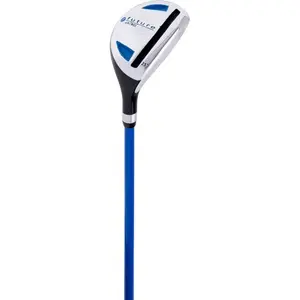
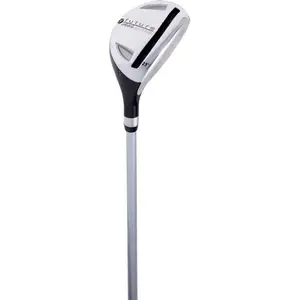
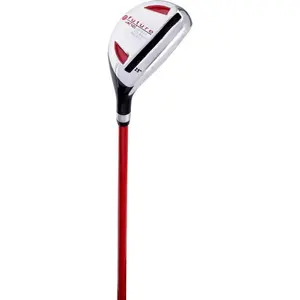
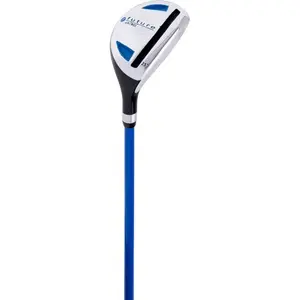
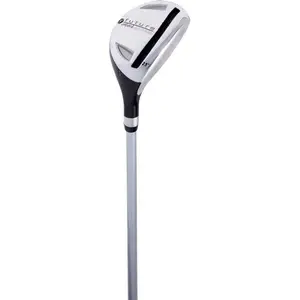
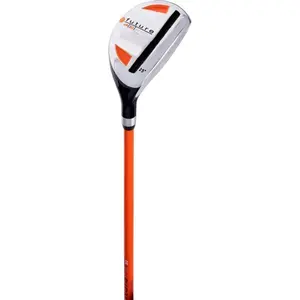
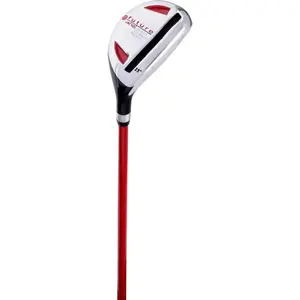
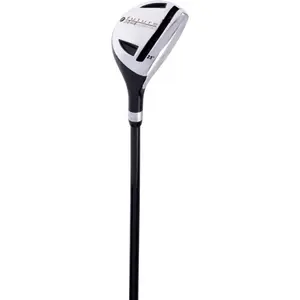
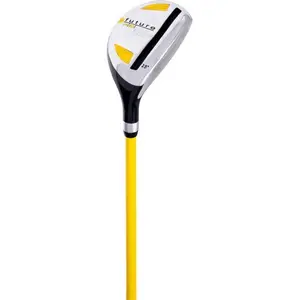
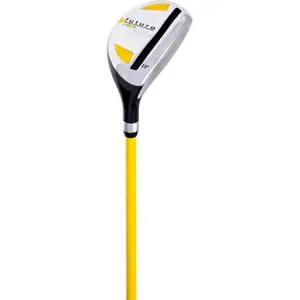
This page dedicated to children's golf hybrids helps to choose the club that replaces the long irons in a young player's bag: a compact head with a low centre of gravity that lifts the ball with little swing speed, an appropriate loft, a lightweight graphite shaft, and a length suited to the child's height, from the first course to junior competitions.
The club that makes long play easier.
Why the hybrid replaces long irons for children
A child swings much slower than an adult, which is exactly what makes long irons almost unplayable at their age: their narrow face and low loft require a very precise strike to send the ball into the air. The hybrid combines the length of an iron with a hollow, wider and deeper head, with the mass placed low and towards the back. The ball then rises effortlessly, even on a slightly fat contact, and the rounded sole glides over the grass instead of digging in. From the fairway as well as from light rough, the young golfer finally gains distance on long holes, changing their approach to a course.
The rest of the bag
Children's clubs also include:
All clubs are listed on the children's clubs page.
Loft, length and shaft: adjusting the hybrid to the player's size
For juniors, the club is chosen based on the height of the child and not their age: manufacturers categorise their models by height ranges, often identified by a colour. A hybrid that is too long forces the player to stand too far from the ball and sweep it sideways, while a club that is too short causes the shoulders to dip. The loft of a junior hybrid is usually more upright than that of an adult model, to ensure a high trajectory at low speed. The graphite shaft, light and flexible, helps the child accelerate without tension in the arms, and a small diameter grip completes the setup, as children's hands struggle to hold onto a grip that's too thick.
How many hybrids in a junior bag
The rules of golf limit the bag to fourteen clubs, but a child just starting out can play very well with half that. A first set generally includes one driver, one hybrid, two or three mid and short irons, one wedge, and one putter. As the child progresses and their distances increase, a second hybrid with a lower loft fills the gap between the driver and the longest iron: it's checked on the practice range that each club sends the ball a distinct distance, with a consistent gap between adjacent clubs. Growth necessitates a regular review of the set, starting with the distance clubs, which are the first to become too short.
Bargains
Good deals can also be found in the bargains, promotions, clearance, sales, Black Friday. The new arrivals feature the latest collections, and items shipped within 24 hours are prepared and dispatched in 24 hours. The highlights of the year follow a stable order: Black Friday in late autumn, year-end holidays, winter sales, French Days in spring, followed by summer sales and back-to-school.
Frequently asked questions
How to play a hybrid as a child?
You place the ball slightly forward of centre in the stance and keep a swing like an iron, striking the ball before the ground. There's no need to try to lift it: the loft and low centre of gravity of the head take care of that.
Hybrid or fairway wood: which to buy first for a junior?
The hybrid, being shorter, is easier to control and handles better from thick grass. The fairway wood goes further from a good position but is less forgiving of mistakes: for a child, it's generally better to start with the hybrid.
When can a child start using a hybrid?
As soon as they can hit the ball consistently with a short iron, the hybrid provides easy distance on long holes. It's not age that matters but height, which determines the club length to choose.
Can an adult hybrid be shortened for a child?
It's not a good idea: the head remains heavy, the club becomes unbalanced, and the shaft, designed for an adult, is still far too stiff. A junior hybrid, lighter and more flexible, allows the child to swing naturally.
Does a child's hybrid need a headcover?
Yes, it's useful: in the bag, the hybrid's head knocks against the irons and the graphite shaft can get marked. A headcover protects the face and paint and allows the child to spot their club at a glance.






