
Children's Riding on Clearance


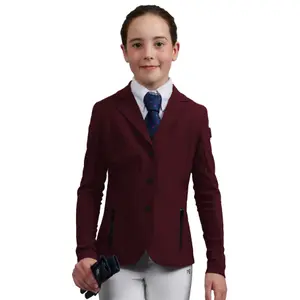


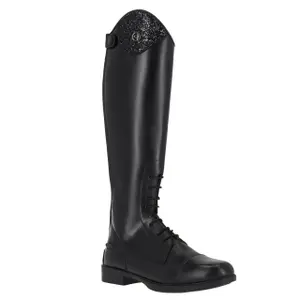


The end-of-line sale for children's riding gear brings together equipment for the young rider: boots Horze, QHP and Horka, boots and mini-chaps, full grip trousers and leggings, back protectors Swing, vests, airbag cartridges Equiline, jackets and hobby horse. Protection, riding attire and comfort at the pony club: a selection designed for a child who grows quickly and rides in all weathers.
Outfitting a young rider who grows fast, for a gentler price.
Back protection, vest and airbag: protecting the back
The protection of the back comes just after the helmet in the gear of the young rider. The European standard EN 13158 classifies protective vests into three levels; level three, the most protective, is required for cross-country in eventing, and the Horka Flexplus junior vest meets this requirement. The back protection alone, like the Swing with zip closure, covers the spine during training, but does not replace a vest where one is required. The airbag vest, connected to the saddle by a strap, inflates thanks to a gas cartridge in case of a fall: after each activation, the cartridge is replaced, like the child cartridge Equiline.
The other clearance items
Equestrian clearance is also available for:
All clearance items are gathered on the equestrian page.
Boots, jodhpur boots and mini chaps: equipping the young rider
To start, a pair of jodhpur boots paired with mini chaps in suede, like those from Q-essentials, is the most flexible solution: the mini chaps protect the calf from stirrup pinch, and the set can be replaced piece by piece as the child grows. The high boots, like the Horze Rover, QHP Romy or Horka Emy, give a neater leg, appreciated in competitions. The Horze Portland, adorned with crystals, are popular with young female riders, and the Horze Polar, lined, keep feet warm in the stable during winter. All have a small heel that prevents the foot from slipping through the stirrup.
Full grip trousers and leggings: the riding outfit
The riding trousers are distinguished by their knee patches, reinforcements placed on the inside of the knees or legs. The full grip model has a silicone coating on the entire inside of the thighs and knees: it improves grip in the saddle and reassures beginners, whether trotting or galloping. The knee grip, limited to the knees, allows more freedom for riders who are already comfortable. The riding legging, such as the Horze Dea or the Red Horse Khloé, which is more flexible and closer to the body, is liked by young female riders; the thermal version, like the ELT Lucky Leni, fleece-lined, is used in winter. The Premier Equine Brava offers the same grip in a classic trouser cut.
Padded jackets, vests and hobby horse: at the stable and beyond
At the stable, the child spends as much time on foot as in the saddle: a long padded jacket, like the Horze Paloma, covers the lower back while grooming, and the LeMieux Ruby keeps warm in cold weather; the sleeveless vest Harry's Horse allows free arms for saddling and brushing. The hobby horse, a stick horse with a fabric head, has become a full-fledged hobby, originating from Finland: children recreate obstacle courses and dressage tests on foot, using the QHP model for example. It's a great way to work on gaits, patterns, and equestrian vocabulary before getting on.
Frequently asked questions
What equipment is needed for a child starting riding?
A standard helmet, boots or low-heeled boots, riding trousers, and gloves are enough to get started. A protective vest is highly recommended and mandatory for certain cross-country events.
Which helmet should you choose for a child on horseback?
Choose a certified riding helmet that fits snugly without any movement or pressure points, with a well-adjusted chin strap. It should be replaced after any serious fall, even without visible damage.
How to choose the right size of riding boots for a child?
Measure the shoe size, the height of the calf, from floor to the hollow of the knee, and the calf circumference. The boot should reach just below the knee without pinching, while allowing a bit of ease for a warm sock.
Is an airbag vest suitable for a child?
Yes, airbag vests exist in children's sizes, with cartridges suitable for their volume. They are often worn in addition to a protective vest, and the strap must always be connected to the saddle.
How to maintain leather riding boots?
Brush off mud after each session, clean the leather with glycerin soap, then regularly condition it with a grease or balm. Let them dry away from a radiator, with boot shapers to maintain their shape.






