
Discounted riding shoes


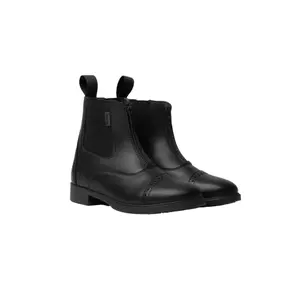


The clearance sale of equestrian boots brings together end-of-line products for safe riding: leather boots Ariat, Horze and QHP, thermal boots Horka and QHP for winter, jodhpur boots Ariat, Harry's Horse, Sergio Grasso, Black Fox and Kavalkade, mini-chaps and leather chaps to complete the leg, available in adult and child sizes, from riding school to competitions.
Your foot securely in the stirrup, at a reduced price.
Shaft height and calf circumference: choosing a tall boot
A riding boot is chosen based on three measurements: size, shaft height, and calf circumference. The shaft should reach just below the bend of the knee, as the leather compresses over time and the boot drops by one to two centimetres. The calf circumference is measured over riding trousers, at the widest point: a boot that's too tight won't close, while a boot that's too loose will gape and allow the leg to float. Shaped boots, like the Ariat Palisade leather ones, are tailored for competition; lace-up models at the ankle, such as the women's Horze lace-up boot, fit better on a slim foot. These clearance items are not restocked.
Other clearance items
The riding clearance also comes in:
All clearance items are available on the equestrian page.
Jodhpur boots and mini chaps: a flexible alternative for club riders
The jodhpur boot stops at the ankle and fastens with side elastics, a zip, or laces: examples include the Ariat Heritage Paddock with laces, the Sergio Grasso Dynamik, and the Kavalkade Meridius. Paired with mini chaps, leg guards that cover the calf from the ankle to the knee, like the Kavalkade Combi or the Harry's Horse Amara, this combination replicates the protection of a tall boot, with more flexibility and less bulk. This duo can also be worn on foot, at the stable, simply by removing the mini chaps. Chaps, covering the entire leg, like the Horze Blake in leather, accompany long rides.
Thermal and waterproof boots for winter at the stable
In winter, feet that remain still in the stirrup cool down quickly: thermal boots, like the Horka Thermo or the QHP Thermo Calgary, add an insulating lining and a thick sole that blocks cold from the ground. The fur-lined Black Fox Cheyennetoo and the QHP Jodhpur Thermo Calgary represent the short version. Made for mud in the paddocks, waterproof models with a membrane, like the Ariat Coniston Max or the Ariat Treadfast Chelsea, keep the foot dry while attending to the horses. The Horka Highlander and the QHP Daan, outdoor boots, are worn for trips to and from the field. A warm but not too tight sock completes the outfit.
Small heel and smooth sole: safety in the stirrup
Every riding shoe features a marked heel: it secures the foot in the stirrup and prevents it from slipping through, which could cause the rider to drag in case of a fall. The sole remains smooth or lightly treaded at the front so that the foot can easily disengage from the stirrup. That's why a city sneaker, with no heel and a thick sole, isn't suitable for riding. For children, the Horze Rover and Portland boots, the latter embellished with crystals, or the QHP Romy, are easy to slip on and accompany the first lessons. Leather should be cleaned after each outing and regularly conditioned with a balm to stay supple and waterproof.
Frequently asked questions
How to put on new riding boots?
Wear thin socks and smooth riding trousers, and sprinkle a bit of talc inside the shaft if the leather sticks. To remove them, a boot pull holds the heel without damaging the leather or seams.
Leather or synthetic boots for beginners?
Synthetic boots, which are cheaper and easy to wash, are suitable for beginners and children who grow quickly. Leather, more expensive, gradually conforms to the leg and lasts for years with regular care.
What size to take in riding boots?
Take your usual size while trying the boots on with the socks you’ll wear when riding. The heel shouldn't lift while walking, and the toes should have a little room without floating.
How to dry wet leather boots?
Stuff them with newspaper, changing it several times, and let them dry at room temperature, away from a radiator that could crack the leather. Once dry, condition them with a suitable balm or grease.
Where does the name of the brand Ariat come from?
Ariat was founded in 1993 in California by Beth Cross and Pam Parker. Its name pays tribute to Secretariat, a famous American racehorse known for his Triple Crown win, symbolising the performance the brand aims to bring to riders.






