
Mountain bike braking: discs and pads

Starting at £47.94
£44.99
Starting at £47.94
£44.97


Starting at £20.42
£19.73


Starting at £271.82
£95.13

Starting at £42.93
£39.26


Starting at £120.89
£106.83
The mountain bike braking section includes complete hydraulic disc brakes, resin or metal pads, Center Lock or six-bolt discs, calipers, levers, and cables, from Shimano, Clarks, Elvedes, Galfer, TRP, or Hayes. Whether you're riding cross-country, enduro, or an electric mountain bike, each part is chosen based on weight, terrain, and descent length.
In a technical descent, it's the braking that provides the confidence to let go of the brakes at the right moment.
Resin or metal: choosing your mountain bike pads
The resin pad, also known as organic, bites right from the first pull and stays quiet, making it pleasant for cross-country and leisure riding; it wears out quickly in mud and does not handle well the heat from long descents. The metal pad, or sintered, can withstand high temperatures and lasts longer, but at the cost of more noise and a longer break-in period.
The models with fins from Shimano add an aluminium radiator to the mount, which lowers the caliper temperature. Elvedes and Galfer make pads for Magura, Formula or Giant calipers, which should be chosen based on the exact shape of the original pad.
Which disc diameter for which activity
A large disc increases leverage and cooling surface: 160 millimetres is enough for cross-country, 180 millimetres is suitable for trail riding, and 200 or 203 millimetres are required for enduro, downhill, and on a electric mountain bike, which is heavier. Many bikes have a larger disc at the front, which provides the majority of braking.
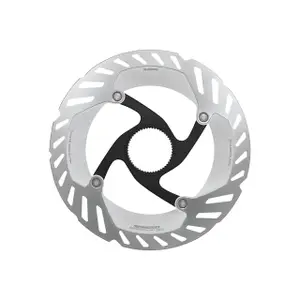
Switching to a larger disc requires a bracket that offsets the caliper, chosen according to the frame's mounting, either Post Mount or International Standard. Shimano Center Lock discs are secured with a ring with internal or external splines, depending on the wheel axle.
Complete hydraulic or mechanical brakes
A complete hydraulic brake includes a lever, hose, and caliper that are already bled: the Clarks kits, supplied with their disc, or the Shimano Deore XT kit with a four-piston caliper can be installed without handling any fluid. The hydraulic system automatically compensates for pad wear and can be modulated with a finger.
The mechanical brake, like the cable caliper from Shimano, is repaired with just a cable and is suitable for entry-level or touring mountain bikes far from any workshop. Its pads can be adjusted by hand as they wear. A galvanized or stainless steel cable, neatly coated, maintains a solid feel.
The selection
Braking components are organized by part:
The mountain bike is completed with bikes, transmissions, wheels and tyres, components, gear, on the mountain bike page.
Bleeding, break-in, and maintenance of mountain bike brakes
A lever that sinks too far or feels spongy indicates air in the system: a bleed is then needed, using the fluid specific to the brand, mineral oil for Shimano or DOT fluid for other manufacturers. Mixing them damages the seals in the system.
New pads require a break-in: about twenty moderate speed brake applications deposits a thin layer of material on the disc and unleashes full power. It's best to avoid touching the disc with fingers or spraying it with chain lubricant, as a contaminated pad loses its bite.
Frequently asked questions
When should I change mountain bike brake pads?
They should be changed when the material wears down to about half a millimetre, or when the spring is nearly touching the disc. In muddy conditions, wear is very fast: a check before each ride, looking down on the caliper, prevents metal on metal braking.
Two-piston or four-piston brakes for mountain biking?
The four-piston calipers apply the pad over a larger surface and maintain their power during long descents, which is why they are popular in enduro and on electric mountain bikes. Both piston systems, being lighter, are enough for cross-country.
How to adjust a disc brake on a mountain bike that rubs?
Loosen both caliper mounting screws, squeeze the lever to centre it on the disc, then retighten while keeping the lever pressed. If the rubbing returns with each rotation, the disc is warped and can be straightened with a disc tool.
How to brake effectively downhill on a mountain bike?
Brake before technical areas, with straight wheels, rather than in the middle of a turn or on a root. One finger on each lever is sufficient with hydraulic brakes; the rest of the hand firmly holds the grip to maintain control.
Why has my mountain bike brake lost its power?
A worn pad, glazed by heat or contaminated by oil, is often the cause. If the lever remains firm, replace the pads and clean the disc; if it becomes soft, a bleed is necessary.






