
Squash and racket clearance
The clearance squash includes rackets from previous ranges by Tecnifibre, Head, Dunlop, Prince, Wilson, or Oliver Sport, as well as indoor shoes with a light sole, suitable for both club players and those new to the court. Each model retains the design that has established its reputation: only the colour or decoration of the frame changes from one range to another.
A racket from a previous range, at a lower price.
Weight and balance: what the name of a squash racket reveals
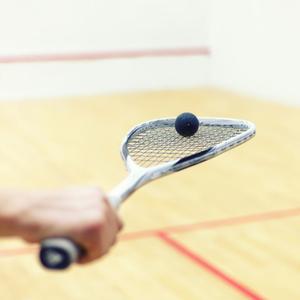
The weight of a squash racket is often indicated in its name: with Tecnifibre, the number attached to the Carboflex and Slash ranges shows the frame's mass in grams, from one hundred and twenty for a control racket to one hundred and thirty-five for a power racket. The World Squash regulations allow up to 255 grams and 686 millimetres in length, but most frames weigh between 90 and 150 grams. The balance completes the picture: a head-heavy design, like that of Wilson Hammer, adds mass at impact and helps with baseline hits, while a neutral balance makes the racket feel quicker at the net and during fast exchanges at the T.
Closeout squash items
The squash clearance sale is organised by type:
Squash shoes: non-marking rubber and lunge support
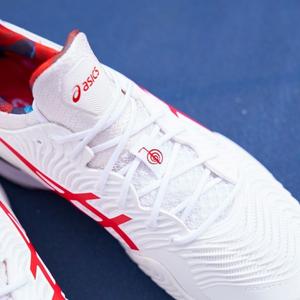
A pair of squash shoes must grip a usually dusty court without leaving marks: its non-marking clear rubber sole is required by nearly all clubs. The game involves deep lunges towards the front corners, where the back foot drags on the floor: a toe reinforcement then protects the upper. Indoor models like the Prince Vortex Pro and Oliver Sport focus on a low sole that keeps the foot close to the floor to limit ankle twists, and on well-defined lateral support to handle rapid starts and stops. A sole that is too thick or too soft on the sides destabilises these repeated lunges.
Other sports on clearance
The clearance extends to other sports: football, running, lifestyle, bicycles, motorcycles, handball, basketball, equestrian, camping, on the clearance page.
Junior racket and goggles: equipping a young player
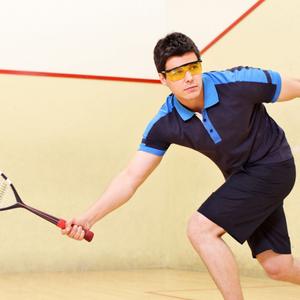
A child starts with a junior racket, shorter and lighter than an adult frame, like the Punch Turbo from Oliver Sport, designed for the early years of play. It allows for strikes without forcing and teaches the motion with a relaxed wrist. Protective goggles are mandatory for all players under the age of nineteen according to World Squash, during training as well as competition, and in doubles regardless of age: the ball can exceed two hundred kilometres per hour in an enclosed space. One should choose a frame compliant with a recognised standard, such as ISO 18527-2, and a blue dot ball, the most bouncy, to allow time to position oneself.
Frequently asked questions
What’s the difference between squash and padel?
Squash is played between two players in an enclosed court with four walls, with the ball needing to hit the front wall with each shot. Padel is almost always played as doubles, on a glass court with a net, using a solid racket with no strings.
How to serve in squash?
The server must have at least one foot in the service box, without touching the line, then strikes the ball towards the front wall between the service line and the high line. It must then land in the opposite back quarter, unless the opponent returns it volley.
Where did squash originate?
Squash was born in the first half of the nineteenth century at Harrow School, near London, where students adapted the racket game using a softer, punctured ball. It would flatten against the wall, hence the name of the sport, which means to crush in English.
Is a racket from a previous series worth as much as a new racket?
Yes, for the vast majority of players: from one series to another, manufacturers mainly tweak the aesthetics and a few construction details. The weight, balance, and head shape, which determine playability, remain very similar.
Should a squash racket be restrung?
Yes, the strings lose their tension over time, even without breaking, and the ball then travels less accurately. A regular player gets it changed when they sense a loss of control, using a lower tension if they seek more power.






